
There is much that can be said about secularism and its history. Much to ponder in regards to how this pernicious beast was placed at the highs of society to be worshiped by all. And certainly, there is much to say concerning the many ways in which it has corrupted the vision of men. But in this instance, I would like to point out a crucial absurdity in this ideology: its inability to provide guidance.
When surfing through the web and its social networks, it doesn’t take long to see the fruits of the liberal and luciferian education that has become normative in most of the world. For the rejection of any coherent metaphysical training, and the relegation of philosophy to modern heretics, has led to a population that fails to recognize the importance and inevitability of faith.
It is now increasingly common to see arguments such as this:
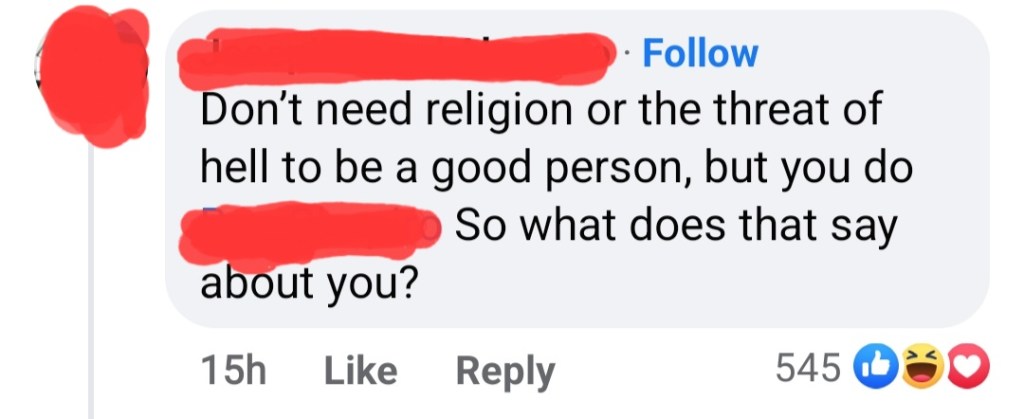
“I don’t need religion, or the threat of hell to be a good person but you do… What does this say about you?”
If we were to truly think critically about such arguments, we would find that their flaw can seem subtle but in reality it is quite immense. But before demonstrating the foolishness of this comment, I would like to make a small pit-stop to show just how profound is the lack of analysis and understanding of such individuals.
This person dares to argue that he does not need the threat of hell to be a good person. That is one hell of a claim! For what then, I must ask, stands as an alternative to the fruits of benevolence if not the fruits of malevolence? And what are the fruits of malevolence if not all sorts of poisonous and bitter fruits that destroy us at a fundamental level? Isn’t this destruction hell itself?
So, you must see that everybody who seeks the good naturally avoids the bad. And they avoid the bad because of the toxic fruits it brings about. You could call this “the threat of negative consequences”, but we simply call it “hell”. In any case, the very idea of “good”, which he claims to possess, implies the threat of the bad that he denies to accept.
But this is just a pit-stop.
The key axiom that is being taken for granted here is that of the “good person”. We need to know what a good person is. Actually, what is “good” in the first place? The oxford definition would be “morally right” and yet, again we must ask, what is morally right? And if one were to ask these questions one would get a variety of answers; some of them appropriate and other less so. But in most cases, I dare to say, people simply take these ideas as if they were self-evident.
If you were to press on and ask them to justify their belief in “the good”, it would be increasingly obvious that their understanding of “the good” is based on an underlying faith. Often times a faith that is not recognized as such. Although the atheist, in order to maintain their affirmations, or lack thereof, might opt to deny any inherent “good” in reality.
Such was the position of David Hume, 18th century skeptic thinker, who claimed that “the good” was simply a classification of convenience exacerbated by our feelings, rather than an intrinsic universal truth. This was the only logical conclusion to his skeptic mentality. However, the unavoidable reality is that even the staunchest irreligious materialist must pick and chose a set of goals to delineate their lives around. Value judgements are indispensable.
The delusion of those who attempt to live a secular life consist of indulging in faith-based claims while pretending to be faith-less. For there is no way to empirically measure that which ought to be considered as “good”. Yet the secular masses of today strongly believe in a good; they always have an opinion, always a mission, always a struggle for some kind of social justice. They believe in that transcendental axiom of a “good”, which they define in a number of different ways, while branding as backwards those who claim transcendence. Well, if this is forward then I’ll remain backwards.
Now, to be fair, their education has failed them. The government, under the principle of secularity, has endeavored to teach them about the world only via a compilation of meaningless scientific facts while at the same time instructing them about certain state-sponsored values under the pretense of their supposed naturalistic self-evidentiality. Escaping, this way, the need to offer the due justification for their moral claims.
This leads to further erroneous claims and beliefs such as the ones in the following comments:
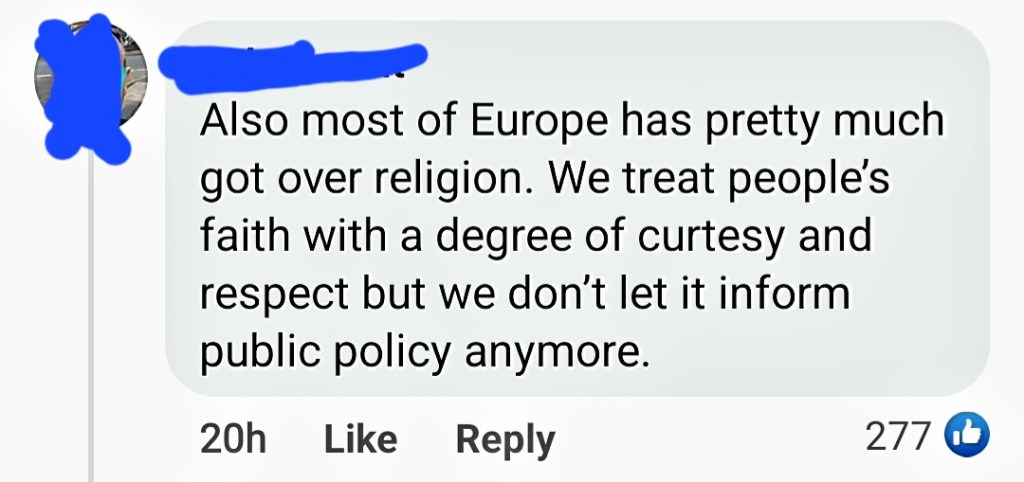
“Europe has pretty much got over religion. We treat people’s faith with a degree of curtesy… but we don’t let it inform public policy anymore.”
This is very interesting as one must then ask what in the world informs public policy then. Scientific facts? Of course not, they are incapable of doing so. Perhaps they inform us in regard to the goal we have selected but certainly they do not suggest any goal at all. As Hume himself realized, you can’t derive an ought from an is.
When Anna Kasparian, from the uber liberal media organization “The Young Turks”, asserted a similar position in an anti-religious rant at her show, she went viral. It happened a few years back and the post is still getting reposted all throughout social media as a triumph against the arguments of the religious conservatives.
In this widely disseminated clip, Kasparian asserts that it is not right for a “mythical book” to be a factor on the dictation of public policy. Now, why should this be or not be the case? I don’t know. She does not offer an argument for this because she simply does not see the irony and hypocrisy in her own line of argumentation. Think about it, by stating that religious scripture should not influence policymaking, Kasparian is already making a faith-based claim that allows her to make this value judgement.
Why should her values be favored over the values of Christians? Only because it is right in her own views. But for these views she cannot offer any impartial, empirical, or scientific backing since these values reside outside the realm of scientific empiricism. And if she were to realize this, and then continued to deny the importance of faith, she would simply have to admit that her desire for policy is guided simply be her own subjective whims and not by anything that is inherently true or good.
Moreover, a consequential issue is exposed here: It is inevitable, in any functioning society, for beliefs to be imposed on others. There is no way around this. This is why, when political reforms are made and immigration policies are debated, or when economic systems are weighed out and freedoms are discussed, faith-based claims must be invoked or at the very least implied. Afterall, only transcendental ideas are capable of providing value judgement and therefore the moral compass needed for policymaking.
Nations are always guided by faith. They are the result of the struggles of men and women with specific values. Where did these values come from? It was not science but cult that brought them about. For this reason, this has been a religious battle since the beginning, and it will be until the very end. How foolish can we be to deny the sacredness of our origins and of our future? Foolish enough, I’d say.
Consequently, we indulge in the pretense of a secular civilization. Then we trick the masses into believing that whatever they deem as good emerged from a simple naturalistic and materialistic understanding of the world. This claim could not be more absurd. However, this fallacy has come to dominate the modern world and it’s exposure could help us understand the value and importance of our faith in public policy and in our personal lives.

 Layman Thought