
One of the most difficult subjects for me to address these days is that of the hierarchical nature of the sexes. Primarily, because we have become suspect of the idea of hierarchies themselves. What once was obvious has now become obscure and even forbidden in some circles. Philosophers with new doctrines have taken a strong grip on an ever-increasing secular world. Distancing us from the wisdom and understanding of old, but more importantly of Scripture.
Therefore, many people, including Christians, have come to accept questionable notions of sexual equality that allow for ever-growing grits to threaten fundamental societal structures. And yet, this is often done with the best of intentions as these many have come to believe, just as modern ideologies suggest, that what is not equal is inherently oppressive. As a result, many within the Christian community dismiss crucial portions and aspects of the Scriptures as if they were misinterpretations or non-essential elements that should be left behind in favor of more “enlightened” views.
Now, the difficulty of this subject consists, largely, in countering the current dismissal of ancient cosmology and of basic metaphysics revealed in Scripture. In addition to this, many of us already have a wide range of deeply held assumptions on the topic of the sexes that, if not put on hold, could prevent new (or should I say old) ideas from being understood properly. For that reason, I ask you to please bear with me a little as I lay all the pieces to the best of my limited ability.

The Long Summoned Historical Context
Much has been said about the importance of understanding the historical context of Scripture. And context is indeed important, but I have noticed that it is often brought up, ironically, to judge the text with modern lenses. “They did not know better”, we would often say. But we should be careful not to use those kinds of remarks too liberally because it may be that, at times, they actually knew better than us. Other times, it may be that ancient men simply did what was appropriate for their time. Therefore, let us actually take our modern lenses off for a quick moment and truly consider what were the circumstances of the sexes for most of human history.
Few things are more obvious than the physical differences between men and women. It could be argued that it was, primarily, the women’s capability for birth and child rearing that shaped the core of civilization. For them, men had to go out into the distance and use their particular strength to work on the most perilous of occupations and to risk their lives in the most gruesome of battles.
For the average woman, childbirth and care was a full-time job. Few had a choice. Not because of inherent social oppression but because nature made it so. Of course, that is not to deny that some men at different places and points in time took advantage of this (to their own detriment), but this is secondary. Only elite and exceptional women would have had the resources in the first place to accommodate themselves in other affairs.
And men, well, they always have been the most expendable of the sexes. They could die by the hundreds, as they often would, and civilization did not necessarily end. But if women died at the same rates, collapse would have been inevitable.
It is then understandable that as society grew in complexity, men were the ones generally more abled to occupy bureaucratic positions and leadership roles, as women were occupied with the most important occupation of all. Additionally, we could consider other biological factors that could favor dominance and interest in particular activities. And if we carefully consider these things and maintain an honest look at the grander picture of history, we will see that humanity has survived thanks to a complementary and resilient alliance between men and women. But these factors are easy to forget or dismiss because we live in much more comfortable times.
For example, many fail to consider that feminist-type ideas have existed for thousands of years but they only took power at the time they did because it was the time in which they could. It was only when the necessary technological and medical advancements came about that the average woman had the opportunity to engage more freely and consistently in a wider range of occupations.
Then, let us consider these factors and how they tie to the punishment given to Adam and Eve. So that we can come to appreciate the evident: That spiritual reality precedes physical reality and not the other way around.

A Reason for Hierarchy
Whether we like it or not (and we ought to like it) reality lays itself out in a hierarchical manner. And it is the Christian faith to believe that God made it so because it is good. But, of course, we live in a fallen world and because of that we can expect to see such things as tainted hierarchies. However, we should not allow these badly practiced hierarchies to make us resentful or else we dip our feet in dangerous waters. Instead, we should seek to understand their purpose and how we can participate in them in the rightful manner.
So far, I can observe some obvious benefits of participating in a hierarchy. The one above has to carry a larger or special burden of responsibility while obtaining a particular sense of meaning and purpose. And the one below has to exercise a level of submission while obtaining the benefit of directions and of receiving various gifts from above. Therefore, both have benefits and duties for their mutual wellbeing. A good example of this would be a villager working and giving taxes to a vigilant king while the king provides direction for the village and help for the villager when he needs it the most.
A tainted hierarchy, on the other hand, would be the one where the villagers are always in revolt, working poorly or withholding their taxes. Or a king who abuses his villagers and does not provide for them, and also mistreats them out of carelessness, arrogance or selfishness. Or both of these problems happening at once. And the result of such a tainted hierarchy would be its doom or, at the very least, its failure to reach its full potential. None of these things will last.
But a Christian hierarchy is a proper one. Where love reigns and the one below submits without grumbling while the one above gives it all. A reciprocal union in good will for the benefit of all who participate in it. And this is how Christ lifts those who are below, not by inspiring them to be rebellious but to be obedient and to work with good intention, and by demanding from the ones above to lead wisely and provide in all things.
Therefore, we must not fall for those ideologies where freedom is supreme or where equality is a god. If Christ himself submitted to a hierarchy, then how could we dare to grow resentful at a call to submission? We should do the contrary and rejoice. For Christ submitted in order to save us, and now we are able to imitate him by submitting in love as well. I know it is not easy because of the fracture that I am about to explain, but it is for our benefit. And if you think about it, not submitting was the sin of Lucifer. That is not a coincidence.
Obey your leaders and submit to them, for they are keeping watch over your souls, as those who will have to give an account. Let them do this with joy and not with groaning, for that would be of no advantage to you
Hebrews 13:17
A Sexual Nature in Hierarchy
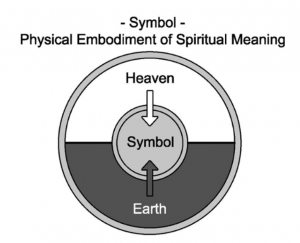
Genesis 1: God created the Heavens and the Earth. This is the first revelation of a hierarchy that we find in the Bible. And as we know that Heaven is above Earth, we should also know that all of creation follows this pattern at different levels of reality. Land and Waters, Spirit and Body, Male and Female. Thus, Man naming Woman. (Naming being an action from above.) Moreover, we can see that Woman was extracted from Man as a helper. Not because Eve was less human than Adam but because he was the first principle in relation to her.
What we observe here is the broader pattern of the masculine and feminine. And it is the reason why we can see The Church, for example, embodying the feminine symbol in relation to Christ despite being composed of both men and women. Or the laypeople embodying the female in relation to the male priesthood. Or even our physical bodies symbolizing the feminine in relation to the mind. Because the active masculine principle is the one which imparts from above while the passive feminine principle receives that which is imparted. And the finality of this sexual expression is the finality of the hierarchy itself: Union.

Back in the Garden of Eden, Heaven and Earth coexisted in harmony. But upon the taking of the forbidden fruit and the resulting fall, a fracture occurred between God and humanity, Heaven and Earth, Spirit and Body, Man and Woman. And these are the things that the ministry of reconciliation is meant to reconcile.
It is because of this fracture that the hierarchy becomes difficult for us, since what is above and what is below do not agree with each other. But when the one above and the one below practice their roles properly, they enter an agreement and with it comes an harmonious unity in which the difference in levels becomes practically unnoticeable. Conversely, if the one above becomes tyrannical or the one below grows rebellious and resentful then disagreement will persist and threaten to bring destruction, making the hierarchy more obvious and increasingly harder to participate in.
Wives, submit to your husbands, as is fitting in the Lord. Husbands, love your wives, and do not be harsh with them.
Colossians 3:18-19
Therefore, a wife is ordered to submit to her husband and the husband is ordered to love his wife as himself. An abusive husband or a rebellious wife would never enter in agreement and would therefore fail to become one. And this is the great contrast between the proper (Christian) hierarchy where love reigns, and the pagan one where union is never the finality.
Therefore a man shall leave his father and his mother and hold fast to his wife, and they shall become one flesh.
Genesis 2:24
In Conclusion
When the apostles are ordering male leadership in two key structures: the Church and the family, they are not simply catering to their times. Instead, they are using profound cosmological arguments to direct Christians into participating in the hierarchy properly.
It is true that many in the old world practiced a tainted hierarchy, but we should not combat mistakes with more mistakes. Denying the hierarchy only causes further trouble, even if it is trouble of a different kind. And this is precisely why the Church has pursued to keep it straight instead of flipping it upside down.
Submission was ordered from the wife, but utmost care and fidelity was ordered from the husband, contrary to pagan standards. So, we are deceived if we think this is unfair or that being below is a negative thing. After all, we are below the angels and angels have abandoned their abode to come to us in past times. What’s more, we should know that Christ’s submission to the Father has never made him less valuable. Hence, we should also know that the levels of a hierarchy do not necessarily speak of intrinsic value but of roles and responsibilities.
But a hierarchy does provide us with the possibility of ascension. If we are below it is so that we can ascend in grace. And when we direct ourselves to the same center, which ought to be Christ, the hierarchy becomes practically invisible as we become of one will, each fulfilling our role in the larger body. And this is all part of the greater reconciliation project that will one day culminate in the total unity of creation, where God and humanity will become one. Is that not more transcendental than simply being equal?

 Layman Thought