
In these times, where the abysmal mouth of the secular dragon threatens to swallow all of civilization, it is of paramount importance to anchor the Christian teachings on their solid cosmological foundations. No longer can we afford to explore the faith solely within a scientific framework. No, we must go back, tracing the footprints that our ancestors left for us, into the world as they understood it. A world full of symbols, patterns, values, and meaning. Why have we forsaken such wisdom? That is a topic for another time. For now, I must recommend a peculiar book that attempts precisely this: to have us remember the ancient language of creation.
The Language of Creation by Matthieu Pageau claims to be a commentary on Genesis and it is, but it is also so much more. Pageau shows us that within the foundational stories of Genesis lies a distinctive language and if we do not know the language then we could easily miss the message being conveyed. After all, what is a strange and lost language to the common folk if not gibberish?
For this reason, I make the invitation to open the book, sit down and prepare for class. Pageau would then present us with the four fundamental concepts of the cosmos: Heaven, Earth, Time and Space. But more importantly, he invites us to leave behind our materialistic and scientific presuppositions around these concepts and instead embrace the knowledge of the ancients.
Perhaps this is the most important lesson the book has for us; that our materialistic understanding of reality is not near enough, and that science can only take us so far. And I believe that this is also the hardest lesson to grasp. For I have noticed that even the most credulous among us struggles to think outside the modern paradigms. After all, how often do we find ourselves trying to identify celestial beings with the same parameters that we use to identify animals on Earth? Quite often I’d say. And how often do we identify the purpose of these animals on Earth solely by their biological needs and functions? We know the answer to that. And yet, in this mind, we read obscure biblical texts that talk about the management of animals in oddly specific ways, or the management of textures, or of a variety of fluids, and we raise our eyebrows while at it. Of course it would seem bizarre to us, but should we be satisfied by that?
That a skeptic, pushing his mind into the unnatural state of empirical scientific thinking, reads these things and finds them strange and superstitious is something that we can afford. But that Christians themselves look at these obscure texts and find them the same way, is something that we absolutely can not afford. Because a Christian could illuminate the way for the skeptic but if he, who says that believes, cannot understand the cosmos that he inhabits and the language that permeates the Holy Book, then we are lost at some level.
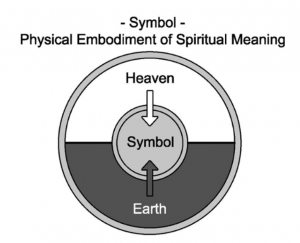
Now, I have read a few comments that put into question Pageau’s ability to detect and demonstrate symbols and patterns simply because, at times, his commentary can seem subjective and arbitrary. I myself must admit that there are some concepts, mainly towards the end of the book, that I’m still trying to fully understand. But I have found that, with perseverance, the concepts not only begin to make sense but become obvious. (This occurs as one sees the patterns repeat themselves over and over again throughout different stories.)
I do hold against the book that it did not spend more time exploring the many examples one could find in the bible. Perhaps that is a call for a sequel since Matthieu avoids stepping too far from Genesis (as the subtitle of the book suggests). But it also seems evident to me that this is not a book for the uninitiated. If one knows at least the basic stories of the bible, then it is much easier to digest the rich and heavy diet of symbolic insight that Pageau provides. Furthermore, I believe that, even within the initiated, there are many who won’t get to understand everything that is explained in the book. Not because it takes too large of an intellect to understand, but because it does require a good deal of patience, something that not everyone will have. But this should be expected because, after all, one does not simply learn a new language overnight.
That said, if I was able to pique your interest, please get the book. Christendom desperately needs to embrace symbolic knowledge, these times more than ever. And The Language of Creation is a fantastic place to start. No one is paying me to say this. I have not even been able to contact Pageau, whom I have heard is living a somewhat secluded rural life. But I firmly believe that God has used him to, at least, shake us out of the limits of scientific thought and awaken the interest of many in the grand language of the cosmos.
 Layman Thought